Leveraging GEO BON and EuropaBON data for EBVs: Japan and Finland comparison
Essential biodiversity variables (EBVs) are strengthening their role as a valuable tool for monitoring changes in biodiversity and for providing a framework of standardised and integrated data aligned with conservation missions at both national and global levels. These variables offer flexibility for the development of region-specific data products, reflecting the uniqueness of each area and allowing for tailored implementation.
A new study supported by OBSGESSION, published in Ecological Research, explores the process of developing EBV lists for Japan by comparing data availability with that of Finland, a country with a broadly similar environment.
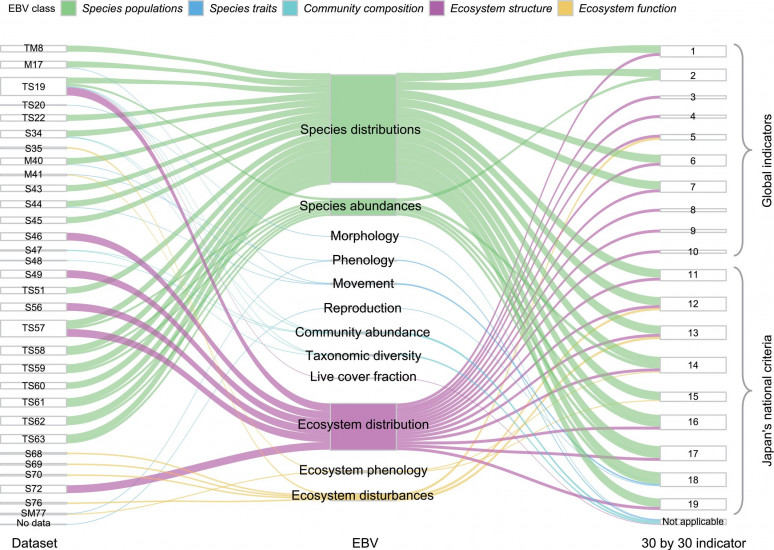
In this publication, titled “National-scale terrestrial biodiversity and ecosystem monitoring with essential biodiversity variables in Japan and Finland”, the authors review the status of primary data for EBVs in terrestrial ecosystems in both countries. They compare Japanese data with the Essential Biodiversity Variables framework of the Group on Earth Observations Biodiversity Observation Network (GEO BON), as well as with EBV lists recommended by the European Biodiversity Observation Network (EuropaBON) and Finland.
Furthermore, the study summarises the EBVs produced using remote sensing and modelling approaches and provides recommendations for establishing regional EBV priority lists.
As a result of this thorough analysis, the authors conclude that Japan has medium-to-high data availability across several EBV classes, particularly in Species Distributions, Phenology, and Environmental Disturbances, which include unique datasets. Data gaps were identified in the EBV classes Genetic Composition, Species Traits, and Ecosystem Structure.
The researchers also offer a perspective on calculating EBVs at the national scale, with a focus on Japan. As more countries and regions develop EBV lists, comparative regional analyses can help identify key resemblances and differences, ultimately supporting more coordinated and effective responses to the global biodiversity crisis.