Soil pH from above: Using satellite data to protect Europe’s forest productivity
As European temperate forests face a mounting "triple threat" of drought, insect infestations, and rising soil acidity, researchers have turned to space-based technology to bridge critical gaps in environmental monitoring.
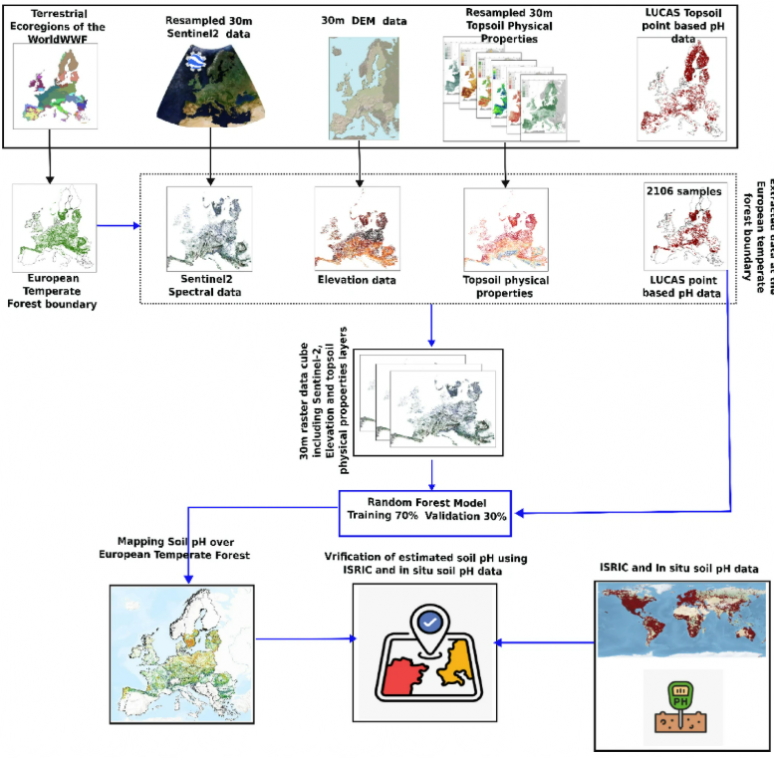
A new study by OBSGESSION partners at the University of Twente utilises Sentinel-2 satellite data and machine learning to map soil pH levels across the continent, providing a high-resolution "health check" for forest ecosystems. The publication titled "High-Resolution prediction of soil pH in European temperate forests using Sentinel-2 and ancillary environmental data", is published in Scientific Reports by Nature earlier this month.
Authors of the text point out that pH levels of soils is a fundamental pillar of forest health. When soil becomes too acidic, it can damage plant root systems and trigger a decline in overall ecosystem productivity. Traditionally, monitoring these changes was limited to "spot checks" - physical soil samples taken at specific locations. This left vast geographic gaps where soil health remained a mystery. To solve this, researchers combined Sentinel-2 spectral data, elevation metrics, and in-situ soil measurements from the Land Use/Cover Area Frame Survey (LUCAS) database into a "Random Forest" machine learning model.
The study revealed a striking correlation between forest types and soil chemistry. While the model demonstrated high accuracy across Central and Southern Europe, researchers noted reduced performance in Scandinavia, where naturally acidic soils and extreme seasonal variations prove more difficult to capture from orbit. Despite these regional variations, the study proves that high-resolution remote sensing can effectively monitor soil properties at scale.
As Europe grapples with a changing climate, these maps offer a vital roadmap for forest management, allowing conservationists to identify acidification hotspots and develop more effective biodiversity and climate adaptation strategies.